Patron of the Mind: Jeffrey Epstein, Intelligence and Consciousness, 2009–2019
What his science funding points to, who pushed back, and who took part
Players are built for phones. On a computer, try the desktop versions.
Abstract
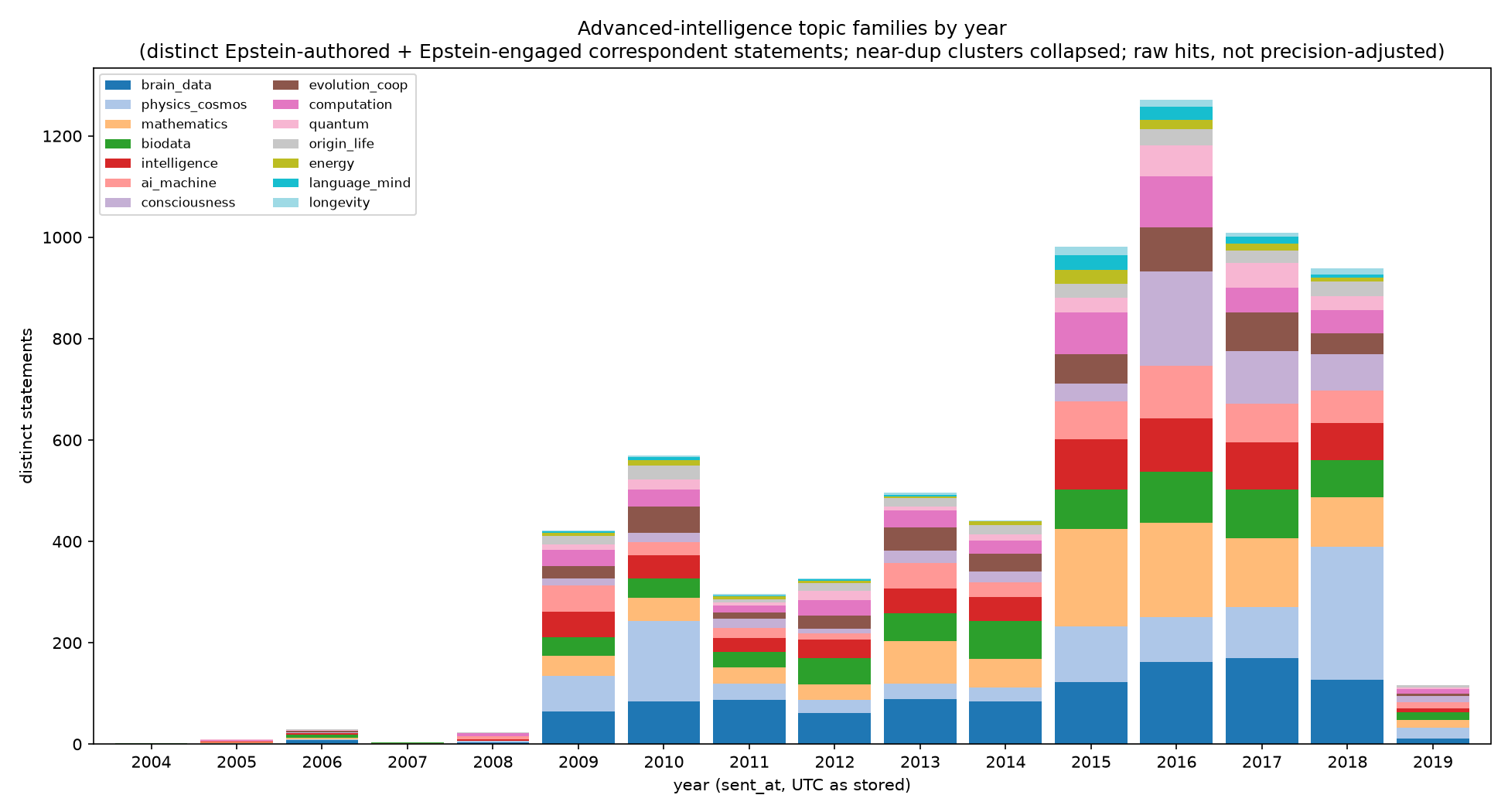
Between 2009 and 2019 Jeffrey Epstein, a financier who in 2008 pleaded guilty to Florida state charges of soliciting prostitution and of procuring a person under 18 for prostitution [S98], wrote about 1,500 distinct passages on intelligence and the mind: machine intelligence, the brain, genes, quantum physics and consciousness. This paper scanned all 1,755,621 non-promotional emails in the Jmail archive, together with its document, message, purchase and photo collections. It separates what Epstein himself wrote from what others wrote to him, and every quoted email was checked against the government's own PDF (128 government originals read in all; 117 cited).
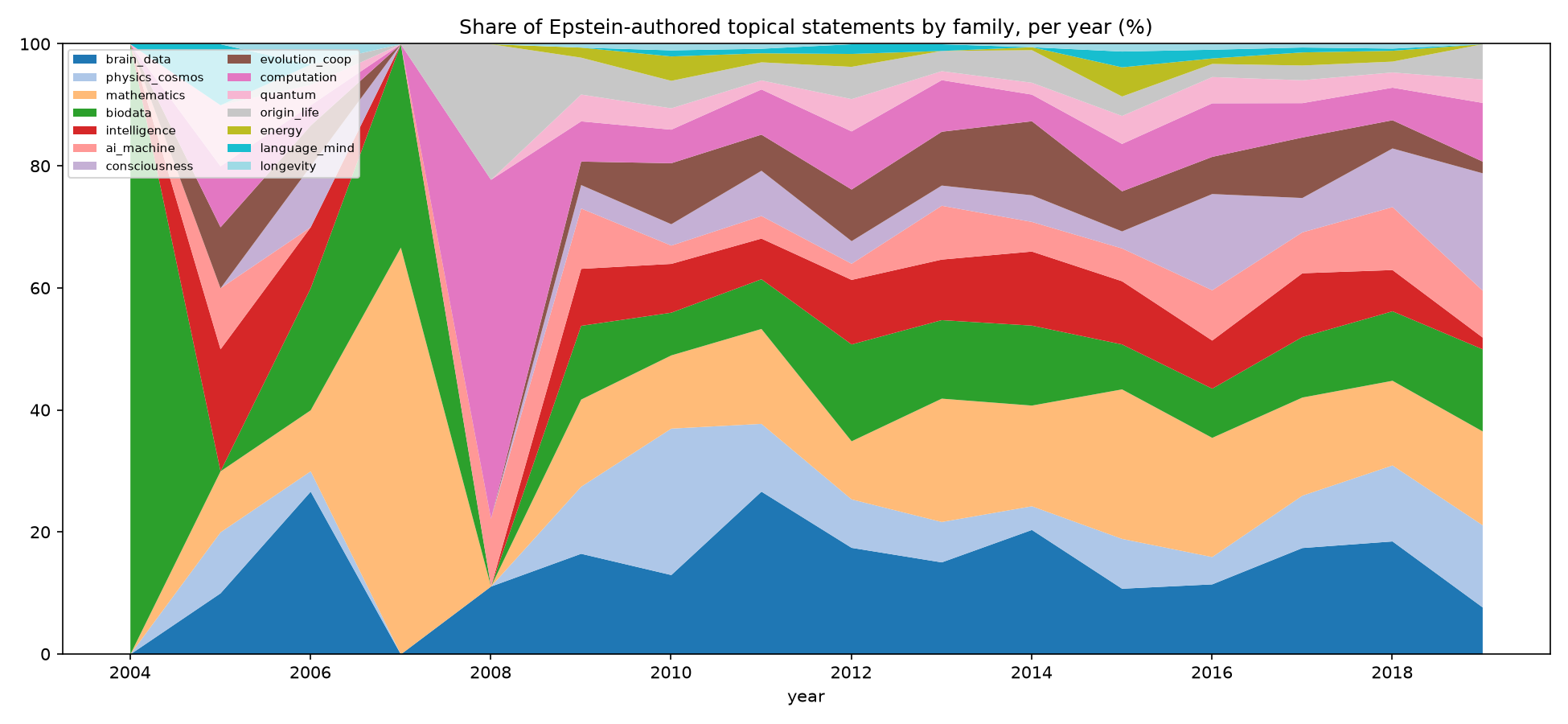
The record does not show a man building artificial intelligence. It shows a patron organised around one recurring idea: that living things, brains included, communicate in hidden, encrypted signals, and that deception is how life protects itself. He wanted to pay code-breakers, including people from the National Security Agency, to "intercept communicaiton between living cells". Machine AI was a small, cheap and early part of the portfolio. The larger flows went to evolutionary mathematics at Harvard, the MIT Media Lab, genome projects with George Church, and, late on, quantum theories of consciousness. At the far edge, in 2018, he discussed investing in a "designer baby and human cloning company", writing that "i have no issue with investing the problem is only if i am seen to lead". No payment for it has been found. Separately, a summary chart of Deutsche Bank's records, e-mailed in August 2019 by Justin Alfano to recipients whose names are redacted ([R-12]), lists a 2014 payment of $500,001 to "Joichi Ito" from an entity in Epstein's account charts, with wire details reading "subcr to Kyara Investments III, LLC to fund Blockstream Investment". The chart does not show who controlled that fund, or whether or when the money reached Blockstream.
Three sides are shown throughout: his aims in his own words; the pushback he met and the decisions he made anyway; and the scientists and institutions who took part, with what they said then and later. Pushback at the time came from institutions and outsiders (Harvard, which refused his gifts after his conviction; a prosecutor; a reputation firm; TED; Craig Venter's office) and, among the scientists, as technical disagreement, most sharply from Noam Chomsky. Moral refusals came mostly after 2019. The pattern the funding points to is a mix of real curiosity, purchased standing, and a steady preference for giving in ways that kept his name off the gift.
Figures
Our own charts from the paper